A strong Data Scientist Resume answers one question for the hiring manager in under 30 seconds: “Can this person take a real business problem, apply the right analytical approach, and produce a result that mattered?” Most data science resumes fail this test because they list tools instead of outcomes, describe responsibilities instead of achievements, and bury the most important information under generic objective statements.
The resume that gets interviews in 2025 is specific, quantified, and structured to pass both ATS keyword filters and human review. This guide walks through every section with the formula that works, common mistakes, and before/after examples.
The Anatomy of a Strong DS Resume
| Section | What to Include | Common Mistake | Length |
|---|---|---|---|
| Header | Name, email, LinkedIn, GitHub, portfolio URL | Including full home address (city only is fine) | 2-3 lines |
| Summary | 3-4 lines: role, years of experience, top 2 specializations, a specific result | Generic: ‘passionate data scientist seeking…’ | 3-4 lines |
| Skills | Technical stack grouped by category; no soft skills here | Listing 40 tools without grouping or context | 8-15 lines |
| Experience | Role, company, dates + 3-5 bullet achievements per role | Job descriptions, not accomplishments | Biggest section |
| Projects | 2-4 projects with problem, method, result, link | Projects without measurable outcomes | 4-6 lines each |
| Education | Degree, institution, year; relevant coursework if recent grad | GPA if below 3.5; irrelevant coursework | 2-4 lines |
| Certifications | AWS, GCP, Databricks, Coursera specializations | Listing every online course ever taken | 2-4 lines |
Writing Project Descriptions That Actually Impress
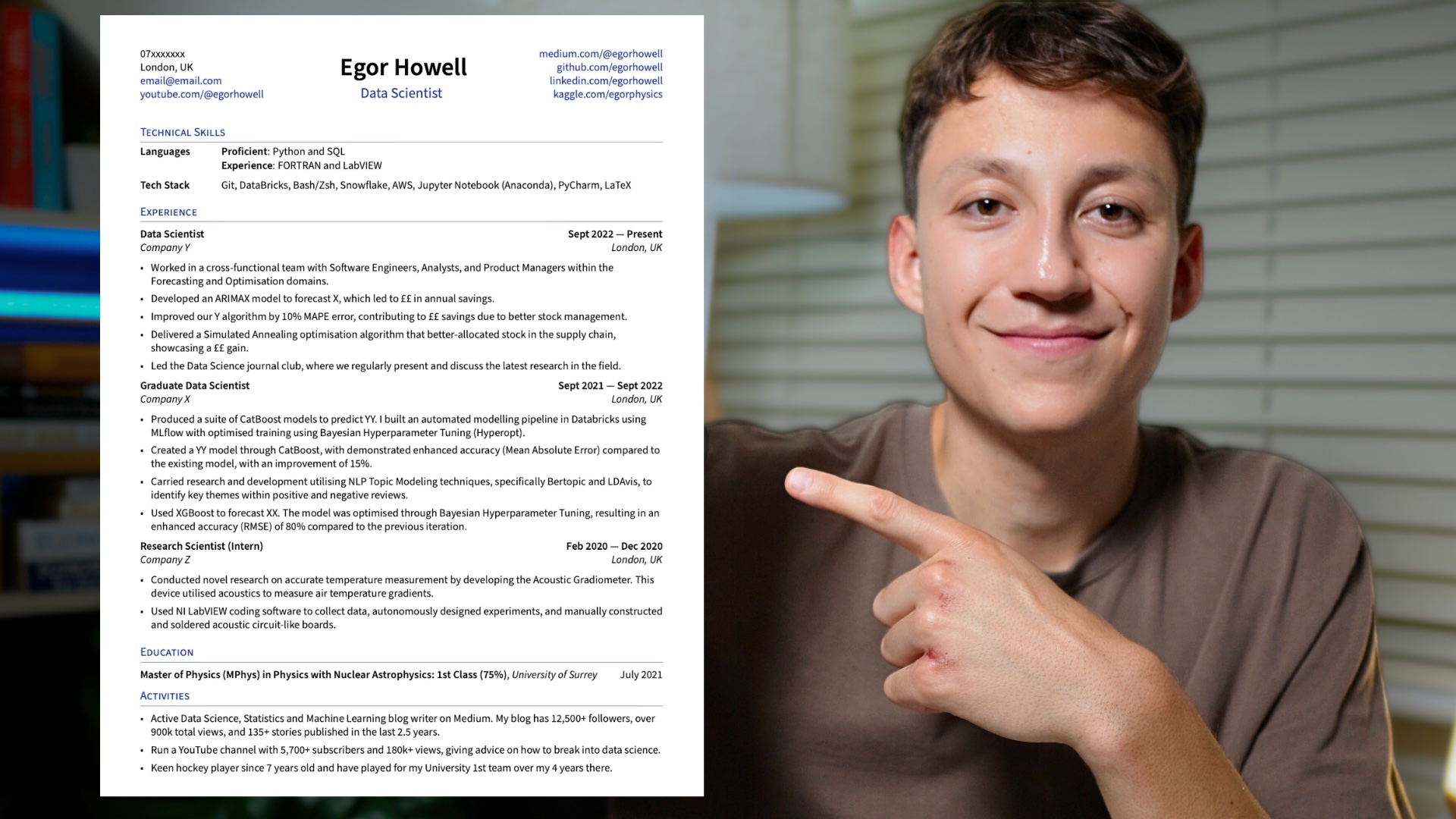
The formula: Problem → Method → Result → Impact. Every project bullet should answer all four.
Weak example: ‘Built a churn prediction model using random forest.’
Strong example: ‘Developed a customer churn prediction model (Random Forest, 87% AUC) on 2M+ user records; model deployed to production and triggered targeted retention campaigns that reduced churn rate by 14% over 6 months, saving ~$1.2M ARR.’
The difference: the strong version names the scale of data, the metric that proves model quality (AUC), what happened after it was built (deployment, campaigns), and the business result with a dollar figure. Any hiring manager can see the value instantly.
If you do not have exact numbers, estimate honestly: ‘reduced processing time by approximately 60%’ or ‘improved model accuracy from 71% to 84%’. Approximations are fine. Vague verbs like ‘contributed to’ and ‘assisted with’ are not.
Skills Section: What to List and How
Group skills by category. Do not list them as a random comma-separated paragraph.
| Category | Examples to List | What to Avoid |
|---|---|---|
| Languages | Python, R, SQL, Scala, Julia | Listing languages you used once in a course |
| ML / DL Frameworks | scikit-learn, TensorFlow, PyTorch, XGBoost, Keras | Listing both TF and Keras separately (Keras is part of TF) |
| Data Engineering | Spark, Airflow, dbt, Kafka, Luigi | Listing tools you have only read about |
| Cloud Platforms | AWS (S3, SageMaker, Redshift), GCP (BigQuery, Vertex AI) | Just ‘AWS’ without specific services |
| Visualization | Tableau, Power BI, Matplotlib, Plotly, Seaborn | Excel charts as a data science visualization skill |
| Databases | PostgreSQL, MySQL, MongoDB, Snowflake, Redshift | Access, SQLite in a professional context |
| MLOps | MLflow, Docker, Kubernetes, GitHub Actions, DVC | DevOps tools you have only used minimally |
ATS Optimization: Keywords That Get You Through the Filter
Most companies use Applicant Tracking Systems that scan resumes for keywords before a human sees them. Tailor your skills section and project descriptions to mirror the language in the job posting.
| Role Type | High-Priority Keywords | Common Differentiators |
|---|---|---|
| ML Engineer | MLOps, model deployment, Docker, Kubernetes, CI/CD, serving | Production experience, latency optimization |
| Data Scientist | A/B testing, statistical modeling, experiment design, causal inference | Business impact quantified |
| Research Scientist | Publications, novel architectures, SOTA, ablation study | GitHub with research code, arxiv papers |
| Analytics Engineer | dbt, data modeling, Looker, Snowflake, semantic layer | SQL fluency at scale |
| NLP/CV Specialist | Transformers, BERT, fine-tuning, CLIP, diffusion models | Hugging Face contributions, model cards |
One Page vs Two Pages: The Real Answer
Under 5 years of experience: one page, strictly. Hiring managers do not read resumes – they scan them. One page forces you to cut the noise and show only what matters.
5+ years of experience: two pages is fine, but the second page must earn its place. Every line should either add new technical depth, show a different domain, or quantify a significant achievement. A second page full of older job descriptions that do not add anything new is worse than a tight one-pager.
Senior / Staff / Principal: two pages is standard. Some research scientist roles accept longer CVs, particularly for academic positions that expect publication lists.
Before and After: Experience Bullets
| Version | Example Bullet |
|---|---|
| Before (weak) | Responsible for analyzing customer data and building machine learning models for the marketing team. |
| After (strong) | Built propensity-to-buy model (XGBoost, 91% precision) on 5M customer records; integrated into email campaign targeting, increasing conversion rate by 22% and generating $400K incremental revenue in Q3 2024. |
| Before (weak) | Worked on NLP project to classify support tickets. |
| After (strong) | Developed BERT-based support ticket classifier (fine-tuned on 80K labelled examples, 94% F1); automated routing for 60% of incoming tickets, reducing median resolution time from 4.2 days to 1.8 days. |
Final Checklist Before Submitting
- Every project and role bullet includes at least one number (%, $, time saved, scale of data).
- Skills section mirrors keywords from the specific job posting you are applying to.
- GitHub and portfolio links work and show recent, relevant work.
- No generic objective statement – replace with a specific 3-line professional summary.
- Saved and submitted as a PDF (not .docx) to preserve formatting across systems.
- ATS-friendly format: single column, no tables inside the experience section, standard section headers.
- Someone outside data science can understand what you built and why it mattered.
The last point is more important than it sounds. If your resume requires a data science background to appreciate, you are writing for the wrong audience. The first person who reads it is often an HR generalist. Make the business impact obvious before the technical details.