Owning a car comes with several benefits that make life easy, but this ease has its own cost. Any investment in a car as an asset begins with buying it, but continues throughout the period of ownership. Maintenance, insurance, and fuel are some named costs that run the daily expenditure.
Accidents, parking tickets, and safety issues are the other spectrum of challenges that revolve around it. Yet, the most understated risk is that of daily usage resulting in damage to the vehicle’s paint. Even a ride across the freeway or a daily commute can expose the car paint to debris, contact, and environmental exposure.
Naturally, painting the vehicle repeatedly is not the solution. A growing solution to this issue is the paint protection film or PPF, which acts as a superficial layer spread over the vehicle’s exterior surface and protects the paint underneath it. In order to learn more about this technology and how it can reduce the understated cost of paint damage, it is ideal to understand some basic aspects.
How Does PPF Work?
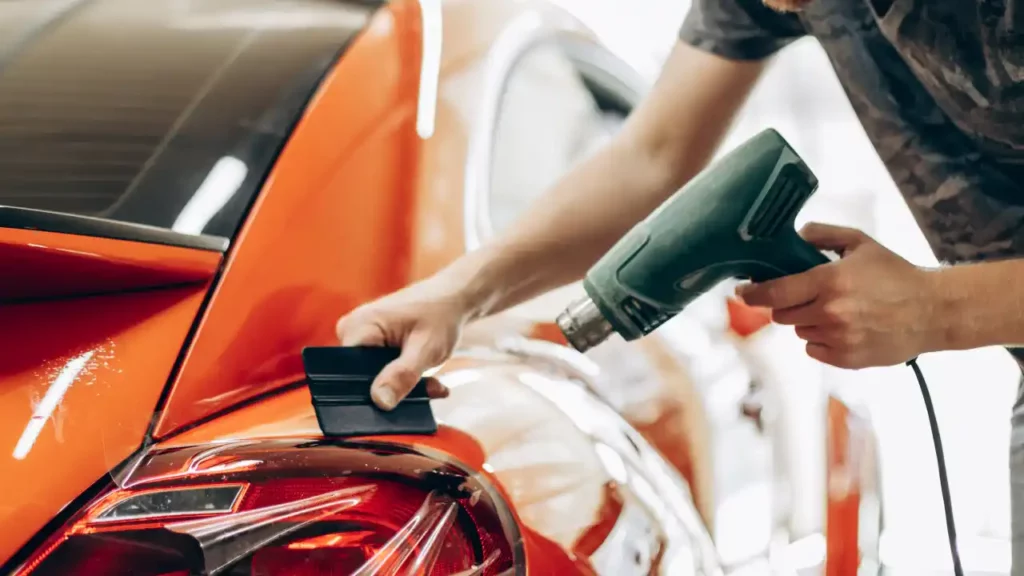
The Paint Protection Film, or the PPF, is essentially a thermoplastic urethane film installed directly over painted vehicle surfaces. It is nearly invisible and does not alter the appearance of the vehicle. It acts as a sacrificial layer that takes surface contact and abrasion, thus making the layer protective against the minor impacts before they reach the paint.
Usually, the areas in the car, like the front bumper and hood, get over-exposed to freeway debris, mirrors and door edges get faced with parking lot scratches or street parking damages. Environmental exposure, such as harmful ultraviolet rays and contamination, may also result in paint etching. These issues can be curtailed by the use of paint protection film.
While other alternatives like the ceramic coating do exist, the PPF may be preferred for its absorption of physical impact and surface contact. Ceramic coating, on the other hand, guards against contaminants and simplifies cleaning. Due to this, a mix of both, that is, a PPF layer for physical protection and an additional ceramic coating layer for its surface protection qualities, may also be considered.
How to Maintain Paint Protection Film for Its Longevity?
The PPF is designed for daily usage and not just for garage-only vehicles. Therefore, a good quality film can sustain consistent usage for 5 to 10 years, even while being subjected to frequent freeway and commuter driving. Maintaining the film is also easy, as no special routines are required. A simple wash, just as it is done for factory paint, is sufficient to clean it.
Moreover, certain high-quality PPF even have the qualities of self-healing when exposed to heat. Even in the case of removal, when done with professional assistance, PPF is capable of preserving the factory paint underneath it rather than damaging it.
Car owners and users looking to learn more about the PPF options available in their area, or who are considering having it installed on their vehicle, can reach out to a certified local installer for a consultation and assessment tailored to their specific make and model.